
Build an Accio Skill for Sample Follow-Up (2026)
sample-follow-up Skill to produce a human-reviewed pack: paid or conditional-free terms, a pre-ship spec-freeze checklist, fee/freight notes from facts only, and stop-loss handoff when the buyer refuses freeze or over-samples. The Skill never auto-sends and never invents fees or lead times. Company-level deposit/deductible policy language lives in the B2B sample policy encyclopedia. Who to follow first is K05 triage; first-reply gaps are K02 four-factors.
Contents
- Why sample follow-up deserves its own Skill
- Download sample-follow-up
- Read SKILL.md: When / Hard rules / Workflow
- Paid, free-with-conditions, refuse (diagram)
- Spec-freeze fields and version IDs
- No auto-send and send_gate
- Stop-loss triggers and handoff
- Upload, bind Agent, dry-run prompts
- Two copy-ready sample threads
- How this chains with K02 / K05 / the policy encyclopedia
- Failure cases and acceptance board
- Localization, warehouse gates, and duty roster
- FAQ
1. Why sample follow-up deserves its own Skill
What burns cash in sampling is rarely the courier sticker alone. It is floating specs, warehouse releases without a version ID, and chat promises that “samples are free” which later appear in screenshots. A familiar factory failure mode: triage never stabilized, yet sample terms already splintered into three stories in Messenger—and when the owner asks whether this order is paid or free, nobody can point to a version.
Packaging sample follow-up as an Accio Work uploadable Skill forces a shared brake across day and night shifts: extract facts, choose a path, list freeze fields, then allow a human to press send. The Agent may draft English conditions; send, fee numbers, and stop-loss escalation stay with people.
Keep neighboring capabilities distinct. K05 inquiry triage answers who deserves human time first. K02 four-factors covers first-reply gaps and long drafts. When the thread enters sampling, switch to this pack. Company-level deposit language, deductible rules, and policy skeletons belong in the Alibaba.com B2B sample policy article—this tutorial teaches per-inquiry follow-up with a Skill, not how to republish the whole policy into chat.
If you have never uploaded a Skill, start with K01: what a Skill is, then come back for this zip. Catalog hub: Accio Tutorials.
2. Download sample-follow-up
Skill package
/downloads/accio-skills/sample-follow-up.zip (~5 KB)
After unzip you should see sample-follow-up/SKILL.md and references/. Avoid nested zip shells when uploading—see K01.
Read the YAML name / description and Hard rules first. Confirm the team accepts: no auto-send, no invented fees or lead times, freeze before ship, hand off on stop-loss. If your free-sample bar is stricter—Gold clients only, or prior wins only—encode that in local Paid/free cues instead of deleting brakes.
The references/ folder ships a minimum freeze list, stop-loss triggers, and paid/free cues. They are scaffolds, not your final SOP. Lighting and molds do not share the same “realistic sample qty” or tooling fee logic—calibrate on real threads.
3. Read SKILL.md: When / Hard rules / Workflow
Key structure matches the download:
---
name: sample-follow-up
description: >-
  Use when an Alibaba.com inquiry reaches sample negotiation: draft paid/free sample
  conditions, spec-freeze checklist, shipping terms, and stop-loss next steps. Never
  auto-send; never invent fees or lead times; human approval required. Not for first
  inquiry triage (use inquiry-triage-priority) or full four-factor reply drafts
  (use inquiry-reply-four-factors). Not for writing the company-wide sample policy manual.
---

# 样品跟进 Skill(Sample Follow-Up)

对内中文备注;买家可见草稿默认英文。输出「人审后才可发送」的样品跟进包:收费/免费条件、规格冻结清单、费用与运费说明(仅用用户给出的事实)、停损触发与交接。

## When

- 询盘已进入「要样品 / 打样 / 确认样」阶段,业务员需要一封条件清晰、可冻结规格的跟进信。
- 买家反复要样但规格漂浮,需要冻结清单与停损建议。
- 主管要求:样品阶段不得自动发送、不得编造费用与交期。

不要用本技能:

- 入站询盘先跟谁 → `inquiry-triage-priority`(K05)
- 用途/批量/预算/认证缺口的首复草稿 → `inquiry-reply-four-factors`(K02)
- 公司级样品政策条文、押金与抵扣条款长文 → 站内百科《B2B 样品政策》;本技能只产出**单次询盘**的跟进包

## Hard rules

1. **禁止自动发送。** 只产出草稿与清单;Messenger / 邮件发送键必须由人按下。输出末尾固定 `send_gate=pending`。
2. **禁止编造。** 样品费、运费、模具/夹具费、交期、证书编号、可抵扣比例——原文或用户当次确认没有的,写「未见 / 待确认」,不得用「行业惯例」填死价。
3. **发运前必须规格冻结。** 冻结清单至少覆盖:型号/SKU、关键尺寸材质、电压/市场、包装、标签语言、声称的认证范围、样品类型(手板 vs 量产代表件)。缺项标红,不得建议「先寄再改」。
4. **收费/免费必须写条件,不得口头「先免着」。** 免费仅在用户确认的条件下草拟(如标准低成本现货 + 主体可核验 + 规格已冻结);定制、开模、高价值物料默认收费草稿。运费承担方单独写清。
5. **停损交接。** 若买家拒签冻结、只压价、超配额索样、或超过用户给定的 N 天仍无冻结:输出 stop-loss 建议,交接销售负责人 / 归档,而不是继续加戏催寄。
6. **禁止私卡与站外收款话术。** 草稿中不得出现私人账户、绕开平台的付款路径;样品费收款路径只复述用户给定的站内/公司对公口径。
7. **不承诺大货价与信保条款细节。** 可写「样品版本号将用于后续大货对齐」;具体信保字段与首单操作留给人工与信保相关技能/专文。

## Workflow

1. **抽取事实:** SKU/品名、市场、样品数量、买家要免费还是付费、已知认证、交期压力、用户已报的费用与运费、用户给定的停损天数 N(缺省则标「待主管确认 N」)。
2. **判定路径:** paid / free-with-conditions / refuse-until-freeze。理由必须引用事实,不得升华。
3. **Output A — Sample conditions (EN, ≤1 page):** 样品类型、数量、费用与运费、交期(仅事实)、冻结前提、有效期。
4. **Output B — Spec-freeze checklist:** 子弹字段;已确认 / 未知分列。
5. **Output C — Next action + stop-loss:** 下一步(等人确认冻结 / 等人确认费用 / 升级负责人);若触发停损,写出交接对象与买家侧收口句(中性、可截图)。
6. **Wait for human Send.** 明确列出「发送前人工必勾」清单。

## Paid / free decision cues(示意,非平台算法)

| 信号 | 倾向 | 备注 |
|---|---|---|
| 标准现货、单价低、规格已可冻结、买家主体可核验 | 可评估免样品费(运费通常买家承担) | 仍须写条件与配额 |
| 定制尺寸/配方、开模、高价值物料、证书试样 | 默认收费 | 模具/夹具费单列 |
| 只要最低价、拒签冻结、超配额连要多套 | 拒寄或预付 + 停损交接 | 不与之讨价还价式加戏 |
| 费用数字用户未给 | 草稿写「待确认」,禁止发明 | 向用户回问 |

## Output template

### Confirmed facts
- ...

### Path
- paid | free-with-conditions | refuse-until-freeze — reason: ...

### Sample conditions (EN draft)
- ...

### Spec-freeze checklist
- [ ] Model / SKU: ...
- [ ] Key dimensions / materials: ...
- [ ] Voltage / market: ...
- [ ] Packaging: ...
- [ ] Label language: ...
- [ ] Cert scope claimed: ...
- [ ] Sample type (hand / production-rep): ...
- [ ] Version ID: ...

### Fee / freight notes (user facts only)
- Sample fee: ...
- Freight payer: ...
- Tooling / deposit / deductible: ...(未见则写未见)

### Stop-loss / handoff
- Triggers: ...
- Handoff to: ...
- Buyer-facing close line (EN, optional): ...

### Seller checklist
- [ ] 未自动发送(send_gate=pending)
- [ ] 未编造费用/交期/证书
- [ ] 冻结缺项已标出
- [ ] 私卡/站外收款话术未出现
- [ ] 需公司级政策条文时已提示人工查阅样品政策百科
- [ ] 首复缺口表需求已转四要素 Skill;队列优先级需求已转分级 Skill

### send_gate
pending
When is deliberately narrow: use once sampling negotiation starts—not for triage, not for first four-factor replies, not for writing the company policy manual. Task prompts should stay equally narrow; never “use this Skill to ship the sample now.”
Hard rules are brakes: no auto-send; no invented fees, freight, lead times, or certificate IDs; freeze before ship; paid/free must state conditions; stop-loss must hand off; no private payment paths; no bulk-price or Trade Assurance micro-clauses inside the sample draft. The last items stop sales chat from pasting store-onboarding payment talk into sampling.
Workflow runs six steps: extract → path → English conditions → freeze list → next action/stop-loss → wait for human send. Fixed output headings make audits cheap: missing headings usually mean the Skill did not fire or the prompt said “just reply somehow.”
4. Paid, free-with-conditions, refuse (diagram)
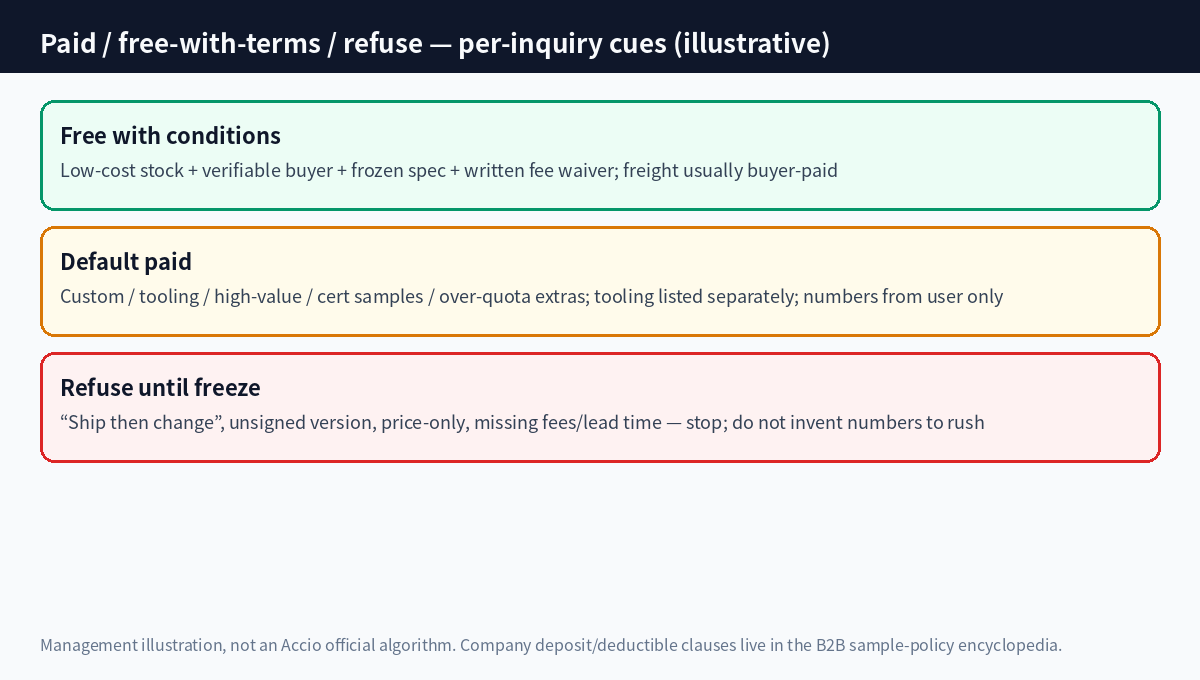
Three illustrative paths—not an Accio official algorithm:
| Path | Typical signals | Draft focus | Do not |
|---|---|---|---|
| Free with conditions | Low-cost stock, verifiable buyer, freezable spec, written fee waiver | Conditions, quota, freight payer, freeze gate | Verbal “free for now”; forever-free screenshots |
| Default paid | Custom, tooling, high-value, cert samples, over-quota extras | Split sample/tooling/freight; numbers from user only | Invent “industry usual” prices; merge deposit vs deductible |
| Refuse until freeze | Ship-then-change, unsigned version, price-only, missing fees/lead time | Neutral need-to-freeze; reopen materials | Invent numbers to rush; insult labels |
Deposit versus deductible sample fees differ in triggers and timelines—that is policy-layer writing in the encyclopedia. If the user did not give a rule, the Skill writes “not seen / to confirm” rather than legislating in chat.
5. Spec-freeze fields and version IDs
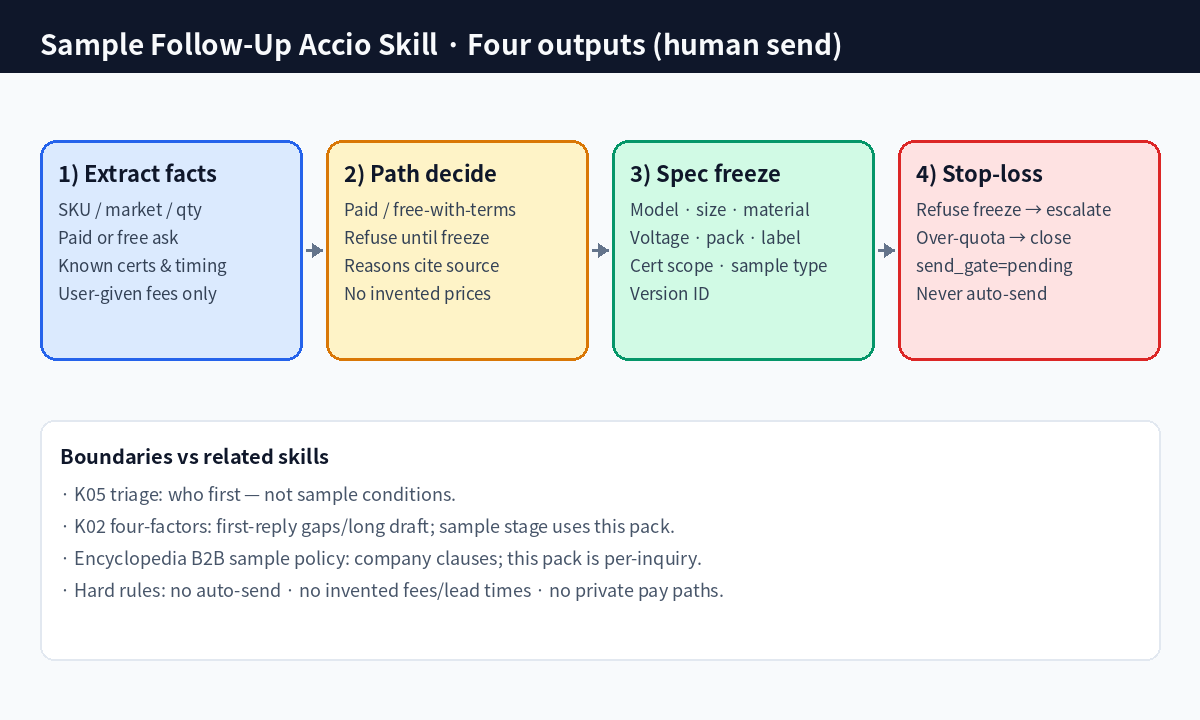
Minimum freeze set (same as references/freeze-checklist.md): model/SKU, key dimensions/materials, voltage/market, packaging, label language, claimed cert scope, sample type (hand vs production-representative), version ID, drawing revision if any, acceptance/deviation window (mark to-confirm if missing).
Version ID is the warehouse release key. Unversioned shipments fuel “wrong goods” disputes. Urgency can buy a rush fee that compresses bench time; it must not buy skipped confirmation. If critical fields are mostly unknown, the path should lean refuse-until-freeze—not a cheerful “samples in three days.”
Treat cert fields conservatively: record what the buyer named; whether you hold valid certificates stays a human check. Neither K05 nor this pack should assert “we have full CE.”
6. No auto-send and send_gate
Hard rule one: never auto-send. The template requires send_gate=pending. Team SOP should park triage results and sample drafts in a “pending confirm” queue, not the live buyer thread. If a client exposes auto-send toggles, default them off. Reject outputs that read as if the sample already shipped.
Human send checklist for the monitor edge: every fee points to user confirmation or master data; freeze gaps marked; no private pay paths; no invented bulk price or lead time; stop-loss escalated when due. Incomplete checklist means no send.
Copy-ready task prompt:
Use the sample-follow-up skill on this sample negotiation thread.
Extract confirmed facts only. Choose paid / free-with-conditions / refuse-until-freeze with reason.
Draft EN sample conditions (≤1 page), spec-freeze checklist, fee/freight notes from my facts only,
and stop-loss handoff if triggers apply. Do not invent fees or lead times. Do not send. send_gate=pending.
7. Stop-loss triggers and handoff
Stop-loss is not a mood. It removes proven low-quality sample threads from prime sales hours. Illustrative triggers in the pack: refuse written freeze yet demand ship-then-change; exceed quota without a bulk milestone; pass user-defined N days with no freeze while only pressing price; demand private payment; unverifiable buyer plus abnormal customer-list or “audit tomorrow” asks; critical dimensions change every reply with no version signature.
On trigger, the Skill should name the handoff owner, a neutral buyer-facing close line, and reopen materials (prepay, freeze form, entity docs). Assume any note can be screenshotted—no insults, no bait quotes.
Sample stop-loss and overall inquiry stop-loss are layers. If the lead was price-only with no decision chain from day one, apply both. This Skill only needs sample triggers written clearly.
8. Upload, bind Agent, dry-run prompts
- Zip per K01 (SKILL.md at folder root) and upload under Capabilities → Skills (or current client wording);
- Bind to a “sample follow-up / sales assistant” Agent—not a sourcing-only Agent; keep K05 and K02 on their own bindings;
- Dry-run with the prompt above; require Confirmed facts, Path, Sample conditions, Spec-freeze checklist, Fee notes, Stop-loss, Seller checklist, send_gate;
- Humans confirm path and numbers before send; open the policy encyclopedia when company clauses are needed instead of letting the model legislate;
- For three days, compare model path vs manager path; edit the cue section that causes misses.
UI steps follow the current Accio Work client. Diagrams below are concept flows for training; replace with redacted internal screenshots in private SOPs if you want, keep public pages on diagrams.
9. Two copy-ready sample threads
Sample A (lean paid + freezable):
Hi, please send 2 pcs custom silicone spatula samples for US retail test.
We need FDA-related docs for food contact, logo embossed, pantone 186C.
Can you waive sample fee? We will order 5,000 pcs if test OK.
Need samples in 10 days.
A solid run leans default paid (custom logo + food-contact sample), freezes color/logo/market/sample type/version, and marks fees “to confirm” unless the user supplied numbers. It does not invent FDA certificate IDs, waive fees unilaterally, or guarantee a ten-day ship without capacity confirmation.
Sample B (lean refuse / stop-loss):
Just ship any similar lamp first, we will tell you the size later.
Also send free samples of all your SKUs. Pay to my personal PayPal is OK.
Expect refuse-until-freeze plus stop-loss: ship-then-change, blanket free SKUs, private pay. Next action escalates to the sales lead; buyer-facing close stays neutral. No mockery, no “sure, PayPal works.”
10. How this chains with K02 / K05 / the policy encyclopedia
- Inbox explosion → K05;
- First reply / four-factor gaps → K02;
- Thread enters sampling → this K09 pack;
- Company fee tiers, deposit/deductible, clause skeletons → sample policy encyclopedia;
- Human tone and pacing drills → S05 how to reply; Skills do not replace coaching.
Acceptance across the chain is simple: triage output must not quote sample unit prices; four-factor drafts must not decide whether sampling is strategically worth it; sample packs must not paste membership-fee payment talk. Crossed duties are a leading indicator of sample disputes.
11. Failure cases and acceptance board
Failure cases
- Treating a Skill draft as already sent while the buyer never received it;
- Promoting ship-then-change into free-with-conditions because the English was polite;
- Inventing unapproved sample fees or “guaranteed certification”;
- Private pay accounts or off-platform payment links in the draft;
- Pushing ship after freeze refusal until warehouse releases an unversioned unit;
- Stop-loss with no owner signature, still free-sampling in a private chat.
- Zip downloads; unzip shows
sample-follow-up/SKILL.md; - Upload and Agent bind succeed;
- Both samples produce path, freeze list, and
send_gate=pending; - Hard rules hold (no invent, no auto-send, no private pay, no skip-freeze);
- Handoffs to K02/K05 recorded; stop-loss signed;
- At least ten real sample threads reviewed in a week; manager override rate falls.
Owner weekly board: sample-thread count, paid/free/refuse mix, freeze-sign rate, median human-send latency, stop-loss sign-off rate. Friday twenty minutes asks only: edit Skill cues, or edit who may approve free samples?
12. Localization, warehouse gates, and duty roster
Local field table idea: path name, 1/3/5 anchors from your real threads, veto items, default freight payer, approver, stop-loss N days, last calibration date. Stale over 30 days gets a yellow flag. Auditable trail: message ID, model output, final human path, whether shipped, whether disputed.
Warehouse must require version ID plus freeze acknowledgment before release. Hand samples and production-representative units must be named differently. Fee lines stay split: sample / freight / tooling / rush—each confirmed or “to confirm.” Free paths must state quota and expiry conditions.
Night-shift assistants may send freeze lists and “fees pending manager” drafts; they may not approve free samples or change version IDs alone. Category anchors belong in the local SKILL copy: battery SKUs add voltage and transport limits; textile embroidery freezes pantone and stitch placement; hardware freezes finish and salt-spray asks.
When Listing fields stay hollow, sample threads stall on unknowns—run structured Listing self-check instead of forever firefighting in sampling. When buyers ask DDP/tax, hand off to HS/logistics skills or a forwarder; never invent tax rates in sample notes. Freeze first, then choose air versus ocean.
Training half-day: morning zip + Hard rules + diagrams + Sample A; afternoon Sample B with forced stop-loss + two historical blind threads. Pass bar: five consecutive threads with zero Hard-rule breaches and manager override under 20%. Quality is path and freeze first; tone practice lives in S05.
Monthly confusion matrix on twenty threads: model-paid→human-refuse and model-free→human-paid rates over threshold mean edit cues, not blame “staff cannot use AI.” Keep buyer-facing English screenshot-safe and narrow; keep internal notes blunt about stop-loss. That split protects both conversion and compliance.
Fee lines that survive screenshots
Keep four fixed lines in the buyer draft: Sample fee / Freight / Tooling or fixture / Rush if any. Each line is either a user-confirmed number or “To be confirmed.” Never crush them into “about fifty dollars shipping included.” Ambiguous sentences get interpreted against you once screenshotted.
Deductible language appears only when company policy already defines it and the user confirms this order qualifies. The Skill must not invent a credit percentage from “we always did it that way.” Deposit and deductible triggers differ—cite the encyclopedia; do not legislate inside Messenger.
Free-path drafts must state quota and expiry—for example, fee waiver for this SKU up to two sets on version V1.0 with buyer-paid freight; excess or spec changes require a new quote. Free without expiry is a hole you dig yourself.
Trade Assurance handoff—light touch
The best gift sampling can leave for a later bulk order is a version ID and acceptance window that can be pasted into order fields. One sentence is enough: bulk will follow this frozen version. Do not expand TA onboarding, disbursement, or chargeback playbooks inside the sample pack—those have their own skills and articles. Clear ownership reduces missed steps.
If the buyer suddenly asks for a formal quotation or RFQ four-part quote, hand off to quotation skills instead of stuffing lock-price clauses into sample conditions. Keep this pack on conditions, freeze, and stop-loss.
Owner board, calibration, and org design
Skills output is input; queues amplify. Paid approvals and free-sample waivers should land in a duty-manager queue, not personal favorites. Refuse and stop-loss visibility stays on a named roster. Without queues, sample follow-up collapses back into verbal chat promises.
Calibrate monthly: fifteen should-be-paid threads, ten should-refuse, five free-with-conditions. Blind the Skill, measure agreement, then edit veto lines before changing models. Keep Asia/Shanghai on internal timestamps; buyer-facing dates can use the buyer’s local calendar. If you write “10 days,” say business versus calendar days and whether the clock starts at freeze sign-off or payment—mark to-confirm when the user did not specify.
Public pages keep concept diagrams; private training may add redacted screen recordings. Wrong-language or stale UI shots hurt trust more than a clean flowchart. After the Skill is live, run a short monthly dispute review: freeze list, path, send record—were facts complete, did brakes fire, was handoff signed? Short meetings, fast rule edits beat long apology essays.
One more operational discipline: keep freeze acknowledgments, version IDs, and free-sample approvals at least until the related bulk order closes or the lead is formally lost. When a dispute arrives, those artifacts beat another thousand words of explanation. The Skill front-loads the discipline so warehouse, finance, and named owners still sign—without those signatures the process is incomplete.
If night assistants keep promising free samples before approval, force the free path to include an approver placeholder; empty placeholder keeps send_gate pending and downgrades the path to paid or refuse. Technology should enforce management limits—not the reverse.
What “good” looks like in a filled output
A gold-standard filled pack states confirmed facts as short bullets tied to buyer phrasing, picks one path with a one-line reason, drafts English conditions under one page, lists freeze fields with known versus unknown columns, splits fee lines without invention, and ends with send_gate=pending plus a seller checklist that is actually checkable. Optional buyer close lines appear only on stop-loss paths and stay neutral.
Bad packs share tells: adjectives without facts (“large US retailer”), certificate numbers nobody supplied, freight “included” without a payer, missing version ID, and a tone that sounds like the parcel already left the dock. Train reviewers to reject on tells, not on whether the English “sounds native.”
When Accio sourcing already structured the buyer’s ask, lean harder on custom signals, cert sampling, and deadline pressure—not on politeness. Buyers may also run Agents; your freeze SLA should follow their project date, not the salesperson’s mood.
Series context for implementers
K01 teaches zip anatomy and upload. K02 drafts first replies. K03/K04 cover listing and HS/logistics self-checks when those domains explode. K05 ranks the inbox. K06–K08 in this series address RFQ quotation packs, weekly store-health diagnosis, and Trade Assurance fulfillment self-check. K09 sits where money and rework concentrate: sampling. Link sideways when a thread changes intent; do not merge every duty into one mega-prompt.
Hub cards and sidebars will list the expanding Skill series as each guide ships. If a neighboring slug is temporarily 404 while another writer deploys, keep the in-body link—search engines and humans both benefit once the twin is live the same day.
Ship the Skill only after Hard rules survive a hostile dry-run: polite free-sample bait, ship-then-change bait, and private-pay bait. If any of those three slips into a soft yes, fix cues before the zip goes to the wider sales floor. Keep the bar boring and enforceable.
13. FAQ
How is the sample Skill different from triage and four-factors?
Triage (K05) only ranks who gets human time. Four-factors (K02) drafts first-reply gaps. Sample follow-up (K09) runs after sampling starts: paid/conditional-free terms, freeze list, stop-loss handoff, human send only.
Will it auto-send messages or ship samples?
No. Hard rules require send_gate=pending; humans press Messenger send. Disable client auto-send in team SOP if exposed.
Can the model simply agree to free samples?
No. Free-with-conditions needs your local cues (stock, verifiable buyer, frozen spec, written waiver). It must not invent waivers from “industry usual.”
Does this duplicate the B2B sample policy encyclopedia?
The encyclopedia covers company fee tiers, deposit/deductible, and clause skeletons. This guide teaches per-inquiry Skill follow-up. Link the encyclopedia for policy text; do not paste the whole policy into chat.
After stop-loss, may sales keep pushing shipment?
No. Output the handoff owner and a neutral close line; named owners must sign. Pushing unversioned samples is a top dispute path.
What must we change in the zip before use?
At least: category anchors, free-sample approvers/limits, default freight payer, stop-loss N days and quotas, risk dictionary. Tune name/description; do not delete Hard rules.
Buyer is urgent and specs are incomplete—ship first?
We advise against it. Use a rush fee to compress bench time; do not skip freeze. Warehouse release should require version ID and freeze acknowledgment.