
Build an Inquiry Triage / Follow-up Priority Accio Skill: Scorecard, Upload and Test Run (2026)
Core rule: When the inquiry inbox overflows, use the uploadable inquiry-triage-priority Skill to sort inbound messages into A (hot follow), B (clarify then follow), C (low-intent archive), and D (risk escalate)—deciding who gets human time first. This Skill does not write a full reply and never auto-sends. For gap tables and English drafts, switch to the K02 four-factors reply Skill. Never invent buyer size, spend, or intent.
Table of contents
- Why a triage Skill (boundary vs four-factors)
- Download & prep: inquiry-triage-priority
- Read SKILL.md (When / Hard rules / Workflow)
- How to set A/B/C/D (diagram & border cases)
- Scorecard dimensions (illustrative, not official)
- Zip, upload, Agent bind, prompt test run
- Sample inquiry drills (with filled triage outputs)
- Working with K02/S05, failure cases & stop-loss
- Acceptance checklist & weekly boss dashboard
- Field table: encode company policy into triage rules
- Gold-standard calibration & CRM handoff
- Duty roster, prior_customer override & versioning
- FAQ
1. Why a triage Skill (boundary vs four-factors)
What factory owners fear is rarely “one reply wasn’t polished enough.” It is opening Messenger to thirty unread threads mixing hot RFQs, empty price asks, competitor probes, and half-finished specs—while reps answer whoever chats best and real buyers cool at the bottom of the queue. The triage Skill turns “who gets human time” from gut feel into rules you can audit.
The boundary with the K02 inquiry four-factors reply Skill must stay hard: K05 only outputs Confirmed signals, a score table, A/B/C/D with reason, next action, and at most three English clarifying questions for bucket B. K02 runs only after a human decides to follow up—listing Use-case / MOQ / Budget / Certification gaps and drafting the reply. Human tone and pacing still live in S05 How to reply to inquiries. If you have never built a Skill, start with K01: What is a Skill, then come back to download this pack.
A simple acceptance test: for the same inquiry, triage output must not contain a concrete unit price, MOQ promise, certificate number, or “we can definitely do it.” The moment those fields appear, you stuffed reply duties into the triage pack. Conversely, a four-factors draft should not decide “is this worth chasing”—that is triage’s job.
Shipping triage as an Accio Work uploadable pack—not a private Excel ranking—means day shift and night shift, veterans and new hires share the same Hard rules. Agents can pre-sort, but the send key and D-bucket escalation stay with humans. Hub entry: Accio Tutorials.
2. Download & prep: inquiry-triage-priority
Download the skill pack
/downloads/accio-skills/inquiry-triage-priority.zip (about 2 KB · updated 2026-09-07)
After unzip you should see folder inquiry-triage-priority/SKILL.md directly. Avoid nested zip shells when packaging for upload—see K01.
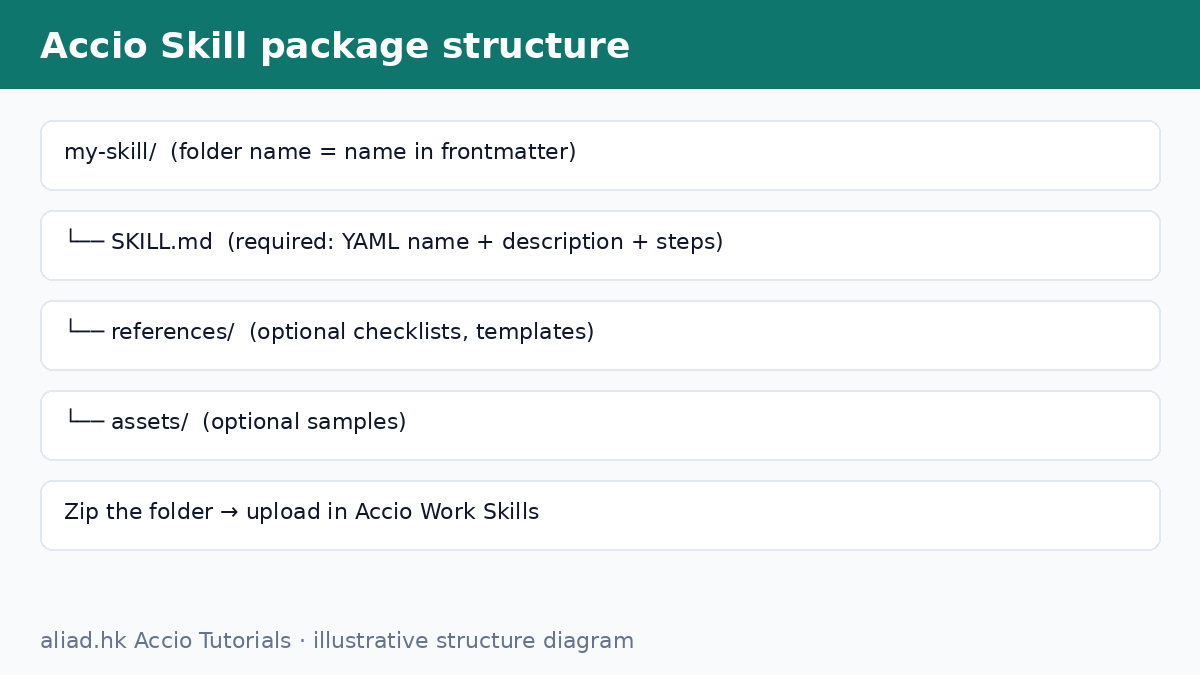
Prep is not “click download and done.” Set up a local workspace first. Recommended layout:
skills-workspace/
└── inquiry-triage-priority/
    └── SKILL.md          ← required; YAML front matter + When/Hard rules/Workflow/Output
# optional (team-owned; not required in this zip)
#   ├── anchors.md        ← category qty anchors, risk lexicon excerpts
#   └── CHANGELOG.txt     ← internal version notes
The only required file is SKILL.md. Without it, Accio Work cannot recognize the pack. YAML needs at least name: inquiry-triage-priority and an English description (when-to-use, and explicitly not for writing the full reply). Body needs When, Hard rules, Workflow, and Output template. Deleting Hard rules before upload is removing the brakes.
Zip root trap (most common upload failure): nesting a folder-already-inside-zip again so unzip becomes inquiry-triage-priority/inquiry-triage-priority/SKILL.md, or exploding loose files with no folder. Correct: select folder inquiry-triage-priority then compress; after unzip, first level is that folder with SKILL.md inside. Diagrams and troubleshooting: K01.
How to open and edit SKILL.md: any UTF-8 editor (VS Code / Cursor / Notepad). First read YAML name / description and Hard rules; confirm the team accepts “triage only, no send, no invented intent.” Then localize three places: (1) quantity-realism anchors (lamps ≠ molds); (2) risk lexicon keywords; (3) A-bucket Next action SLA (2h / 4h). Do not delete brake clauses to “make the model bolder.”
Version comment tip: put an HTML/Markdown comment above the YAML or on line 1, e.g. <!-- internal: 2026.09.07-a | A-SLA 4h | risk-lexicon v3 -->. Tutorial download filename can stay stable; local copies must roll back to “which threshold broke the A/C border.” Companion download (this page does not replace its tutorial): inquiry-reply-four-factors.zip (K02). The triage pack is tiny—rules, not prose; value is discipline, not model flourish.
Pre-build checklist (paste into team wiki): (1) UTF-8 editor installed; (2) skills-workspace/inquiry-triage-priority/ created; (3) previous zip backed up if any; (4) A-bucket SLA and D-owner roster agreed; (5) 3–4 real hard-to-call inquiries ready for test runs. Skipping (5) means self-deception with perfect samples.
Edit order: Hard rules local vetoes and risk words → Workflow quantity anchors → description when-to-use English sentence. Do not rename Output headings first; the six English titles are the shared language across shifts—renaming breaks dashboard fields.
If you start from the K01 blank template: use this zip as the structural reference, copy section by section, then fill category policy. If you already have an old triage pack: diff Hard rules first and confirm “no auto-send / no invent / no price-cert promises” still exist before tuning score anchors.
3. Read SKILL.md (When / Hard rules / Workflow)
Key excerpts matching the download file, for side-by-side edits:
---
name: inquiry-triage-priority
description: >-
  Use when scoring/triaging Alibaba.com or Accio inbound inquiries for follow-up
  priority — not for writing the full reply (use inquiry-reply-four-factors for that).
---

# 询盘分级 / 跟进优先级 Skill

## When
国际站或 Accio 相关入站询盘堆积、业务员不知先跟哪封时使用。输出分级与下一步动作,不代替完整回复起草。

## Hard rules
- 不编造买家公司规模、订单金额或采购意向;原文没有的信号标为「未知」。
- 不自动发送任何消息;只输出分级结果 + 可选追问草稿。
- 对疑似垃圾/同行刺探/纯比价 tire-kicker 打标,措辞中性,禁止侮辱性语言。
- 不承诺价格、MOQ、认证;需要回复草稿时指引人工改用 inquiry-reply-four-factors。
- 分级输出中禁止出现会员费、开店套餐或银行收款账户信息。

## Workflow
1. 从询盘原文提取信号:产品指向、规格清晰度、数量/MOQ、预算线索、认证要求、回复紧急度、垃圾/风险迹象(能抽尽抽,缺则标未知)。
2. 按维度打分(示意量表,非官方算法):规格清晰、数量现实性、预算信号、认证诉求、紧急度、垃圾风险(反向)。
3. 归入四档并写明理由:
   - A 急单可跟:信号足、意向可信、应优先人工跟进
   - B 补信息再跟:有产品指向但缺口大,先发短问再排期
   - C 低意向归档:信息空洞或明显 tire-kicker,低优先级
   - D 风险缓跟:疑似同行/欺诈/敏感合规,先人工销售负责人过目
4. 建议下一步:X 小时内回复 / 先问最多 3 个问题 / 归档观察 / 升级人工销售负责人。
5. 若为 B 档,可附简短英文追问列表(最多 3 条);完整四要素回复改走 inquiry-reply-four-factors。

## Output template
### Confirmed signals
- ...
### Score table
| Dimension | Score (1-5) | Note |
| ... | ... | ... |
### Bucket
- A / B / C / D — reason: ...
### Next action
- ...
### Optional questions (EN, max 3, for bucket B)
1. ...
### Seller checklist
- [ ] 未编造公司规模/金额/意向
- [ ] 未自动发送
- [ ] 风险档已升级人工
- [ ] 需完整回复时已转四要素 Skill
When stays restrained: use when inquiries pile up and you need priority; it explicitly does not replace full reply drafting. Mirror that restraint in Agent prompts—avoid “use this Skill to reply to the customer.”
Hard rules are five brakes: do not invent size/spend/intent; do not auto-send; label spam/competitors neutrally; do not promise price/MOQ/certs; never put membership fees or bank collection details in output. The last one stops store-opening sales copy from leaking into inquiry triage notes.
Workflow is five steps: extract signals → score dimensions → assign bucket with reason → suggest next action → optional short questions for B. Scores are an illustrative scale, not an Accio official algorithm; you must localize “quantity realism” (two lamp samples can be fine; two custom mold sets should raise flags).
4. How to set A/B/C/D (diagram & border cases)
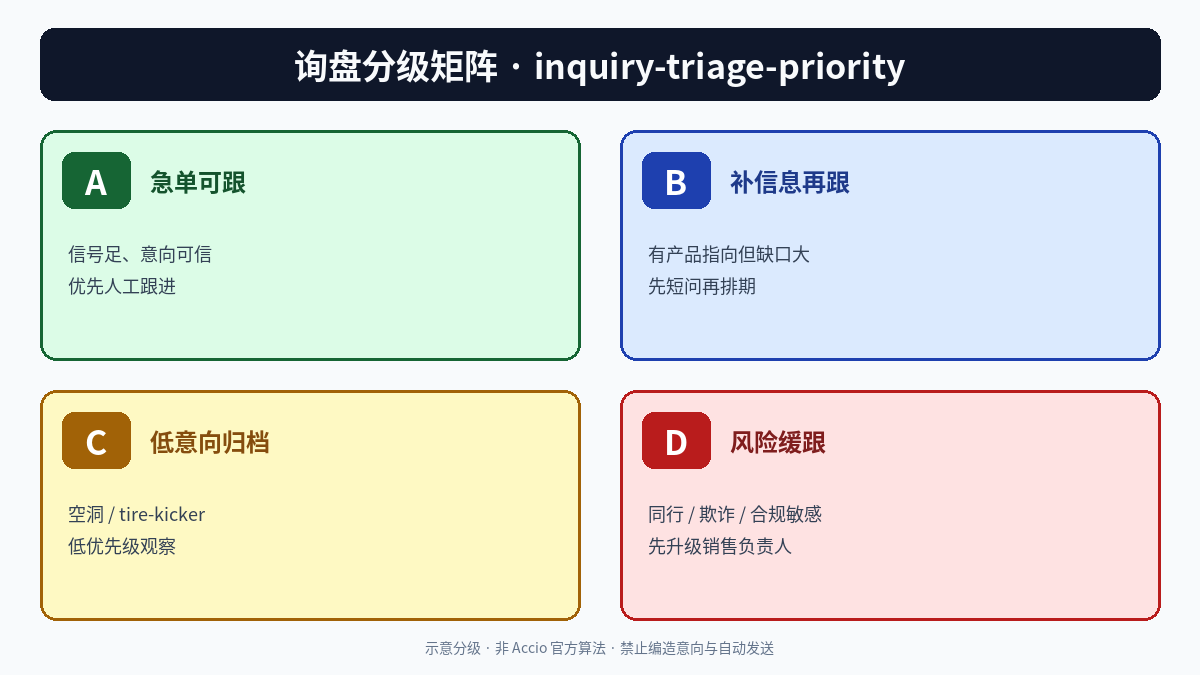
| Bucket | Meaning | Typical signals | Default next action |
|---|---|---|---|
| A Hot follow | Priority human time | Specs clear, qty realistic, destination/cert or deadline pressure | Human follow within X hours; open K02 only if a draft is needed |
| B Clarify then follow | Fill critical gaps first | Product pointer present, but use-case/qty/budget mostly unknown | Send ≤3 English short questions, then re-triage |
| C Low-intent archive | Low-priority watch | “Send price / catalog” with no spec and no qty | Archive / light template touch; do not burn prime sales hours |
| D Risk escalate | Human review first | Suspected peer, fraud phrasing, demand for full customer lists, compliance sensitivity | Escalate to sales lead; no insults, no fake quotes to bait |
Force a one-sentence reason on every bucket—otherwise you renamed a black box. Recommended templates (paste into Output):
- A: Bucket A — reason: verifiable specs (…) + realistic qty (…) + cert/deadline pressure; signals support a meaningful human conversation.
- B: Bucket B — reason: product pointer (…) and destination present, but qty/budget/use-case unknown; clarify before scheduling.
- C: Bucket C — reason: no spec, no qty, no destination—price/catalog only; do not consume prime hours.
- D: Bucket D — reason: suspected peer/probe signals: … (quote source phrases); escalate to sales lead; no auto-quote.
Border A vs B: “Need 500 pcs LED panel, 6000K, for warehouse in Poland, need CE, quote this week”—spec, qty, destination, cert, deadline → A. Change to “Interested in LED panel for Poland, please advise”—product + destination but missing qty/spec/cert → B. Dividing line: can key signals support one meaningful human conversation?
Border B vs C: “Looking for your portable blender, ship to USA” has a clear SKU pointer → B (worth ≤3 questions). “Send price list / catalog ASAP” with no product pointer → C. Dividing line: is there a product pointer worth clarifying? No pointer → do not burn question quota.
Border C vs D: “Lowest price all products” alone can stay C. Add “send all your Europe customers / factory visit tomorrow / pay outside platform” → raise to D. Dividing line: any strong fraud/peer signal forces D regardless of score; D is a veto, not “low A.”
Common mis-buckets: (1) polite long English lifted to A (tone ≠ intent); (2) ASAP empty asks lifted to A (urgency words do not fill spec gaps); (3) price-only C chased as B; (4) D crushed into C “just watch” with no escalation owner; (5) prior-customer new RFQs dumped into C by the model (see override below).
prior_customer override: if input marks prior_customer=true (CRM win in last 12 months), Hard rules should say “never output C directly”—at least B and notify the original owner. That is org policy overriding cold model scores so AI triage does not injure relationship accounts. Conversely, new accounts + price-only + all-category asks—even in elegant English—prefer C or D.
Reason QA: must point to “which source phrases” support the bucket. Pass: “reason: source has 800 pcs + CE + FOB 11-13.” Fail: “reason: looks professional”—unauditable. When a manager changes the bucket, the new reason must also cite source text; letter-only edits are forbidden.
Border drills: re-label the same inquiry after scrubbing qty, then after scrubbing risk words, and watch whether the bucket moves per rules. If scrubbing qty still leaves A, vetoes are missing from the Skill; if adding “send customer list” still leaves C, the D lexicon is not active.
5. Scorecard dimensions (illustrative, not official)
The 1–5 scores below are a localization starting point. Calibrate weekly with real win/loss samples—do not chase “pretty model scores.”
| Dimension | 1 (weak) | 3 (mid) | 5 (strong) |
|---|---|---|---|
| Spec clarity | Category only | Material or size present | Key specs verifiable against listings |
| Qty / MOQ realism | None or extreme | Qty present but sample vs bulk unclear | First order + target volume clear and category-sane |
| Budget signal | None | Vague “cheaper please” | Price band or landed-budget language |
| Certification ask | None / irrelevant | Mentions market compliance without naming certs | Names required certs you can check against holdings |
| Reply urgency | No deadline | Mentions project milestone | Clear due / start date and realistic |
| Spam risk (inverse) | Strong spam/peer signals | Suspicious but thin | No risk signs (score 5) |
Implementation tip: write vetoes per bucket first. Example: spam risk ≤2 → D; spec and qty both ≤2 with no budget → lean C; spec ≥4 and qty ≥3 → lean A or B. Do not cut four buckets with one total-score line—weights differ by category; lamp vs mold “qty realism” is not the same ruler.
Output must land under six headings: Confirmed signals, Score table, Bucket, Next action, Optional questions, Seller checklist. Default Seller checklist: no invented size/spend/intent; no auto-send; risk bucket escalated to human; full reply routed to four-factors Skill when needed.
6. Zip, upload, Agent bind, prompt test run
Walk the real path: edit SKILL.md → zip → upload → assign Agent → write when-to-use and task prompt → verify six-block output → troubleshoot.
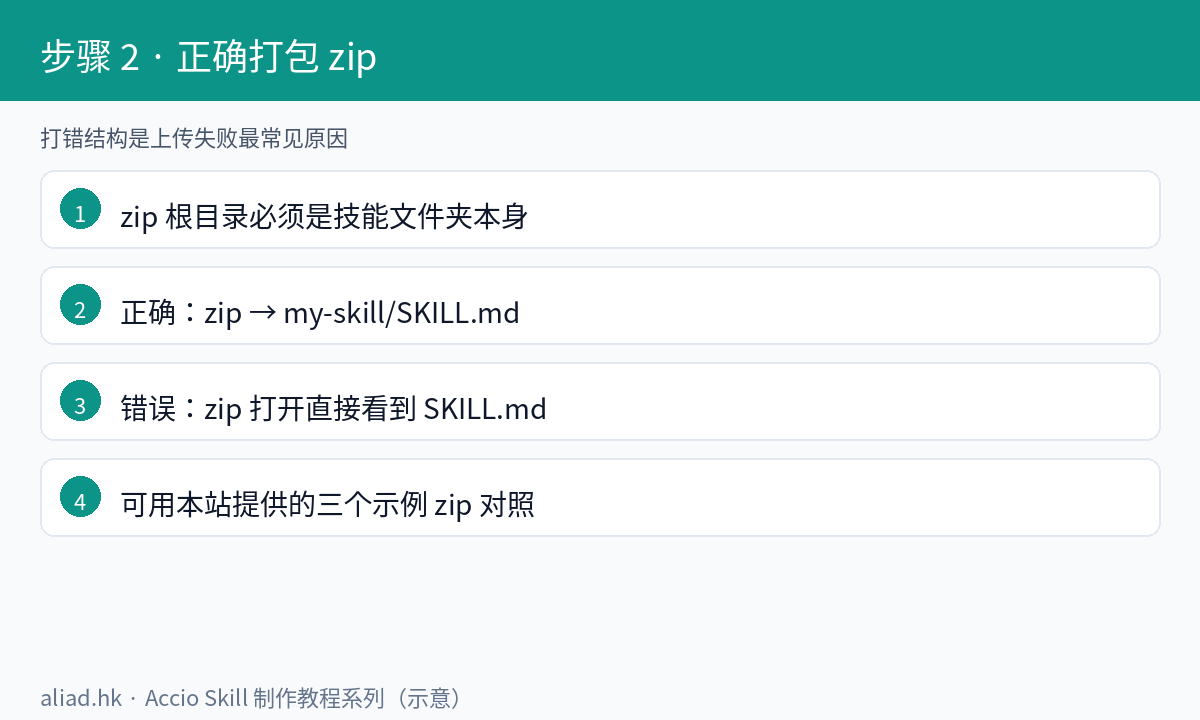
- Zip: in Explorer select folder
inquiry-triage-priority(SKILL.md directly inside) then compress; orzip -r inquiry-triage-priority.zip inquiry-triage-priority. Unzip yourself once before upload to verify paths. - Upload: Accio Work → Capabilities → Skills (or the client’s current skill-upload entry) → install zip. Success means list shows
inquiry-triage-priority.
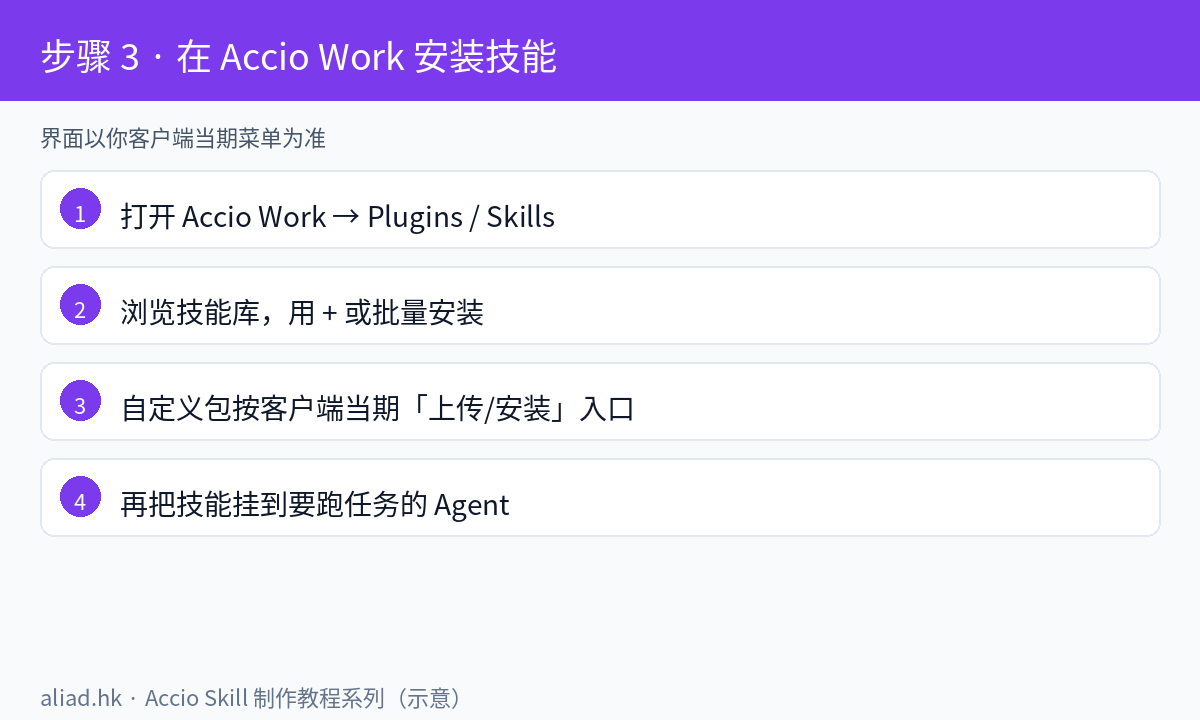
- Assign Agent: attach to an “inquiry triage / sales assistant” Agent—not a sourcing-only Agent. Full replies still use K02
inquiry-reply-four-factors. One Agent may host K05+K02, but prompts must say “triage first, then reply only after human confirm.” - description / when-to-use quality: YAML description should fire on “inbox overflow / need priority” and avoid “write a full sales reply.” Weak: “helpful for sales.” Strong: triage / score / A-B-C-D / do not draft full reply.
Three prompt contrasts (run each on purpose during tests):
- Good: Triage this inbound inquiry with the inquiry-triage-priority skill. Extract signals, score dimensions, assign A/B/C/D with a one-sentence reason, suggest next action. Do not draft a full sales reply. Do not send.
- Bad (miss / drift): Help with this inquiry. — no Skill name, no output limits; models often write long sales letters.
- Bad (duty pollution): Use inquiry-triage-priority to write a complete reply with price and MOQ. — conflicts with Hard rules; even with the name it invites quotes = failed prompt.
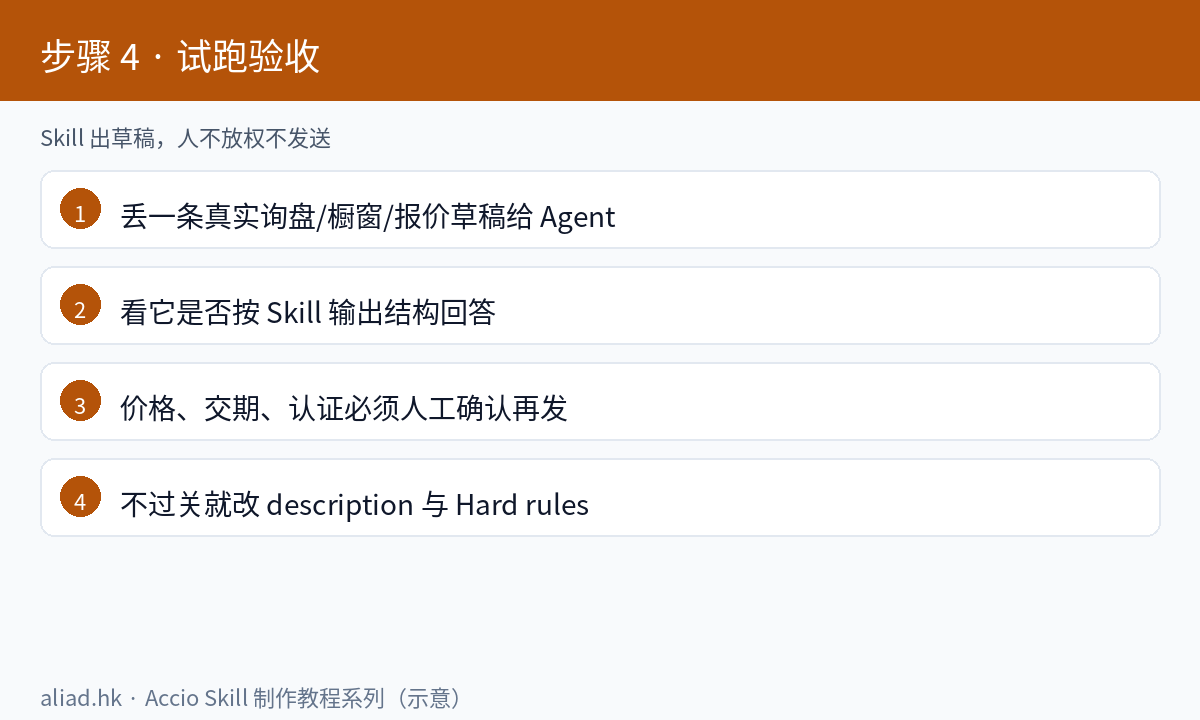
How to accept six-block output: results should show Confirmed signals, Score table, Bucket, Next action, Optional questions (substance only for B; A/C/D may say none), Seller checklist. Missing any main heading → Skill did not fire to template. Bucket needs a reason; Score table uses 1–5 and marks unknowns—never invent company size.
Troubleshooting when the Skill is not called: (1) nested zip / name missing from list; (2) Agent not assigned or old same-name pack still enabled; (3) prompt omitted full name inquiry-triage-priority; (4) description colliding with “write reply” tasks; (5) attached to a sourcing Agent. For three days, compare model vs manager buckets; edit the dimension where gaps cluster. Test with real hard calls—perfect samples hide threshold bugs.
After upload, run a negative test: deliberately use bad prompts (“Help with this inquiry” / “write a full reply with price”). SOP should catch drift—if output shows unit price, MOQ, cert numbers, or send-ready tone, log a fail and fix description; do not blame “the model being too proactive.”
when-to-use can add a border sentence: Prefer this skill when the user asks which inquiry to follow first, how to prioritize the inbox, or to score A/B/C/D. Do not use when the user asks to draft the full sales email. That sharply cuts collisions with K02.
Keep an install log: upload time, internal version, operator, Agent name, sample IDs, six-block pass/fail. When incidents hit, read the log before asking “who just uploaded a Skill?” in chat.
Two CLI reminders (Linux/macOS): under skills-workspace run zip -r inquiry-triage-priority.zip inquiry-triage-priority; before upload, unzip -l inquiry-triage-priority.zip | head should show first path inquiry-triage-priority/SKILL.md, not an extra outer folder. Windows users: compress in Explorer, then unzip to verify the same path.
Smoke order after Agent bind: sample 4 (clear C) first—if the model lifts to A, description/vetoes failed; do not open production queues. Then sample 1 (A) to confirm it does not refuse. Then sample 3 (D) to confirm escalation, not quoting. Pass all three before exposing the triage Agent to live unread.
7. Sample inquiry drills (with filled triage outputs)
Each sample below includes a filled mini output you can compare against (illustrative, not the only correct answer). Check: cites source facts, invents nothing, bucket reason holds, B questions ≤3.
Sample 1 (leans A) · inbound:
Hi, we need LED desk lamps for a corporate office fit-out in Germany.
Qty: 800 pcs first order, possible 2000 pcs/year.
Prefer 4000K, EU plug, dimmable. Need CE docs.
Target FOB around USD 11-13. Please confirm if you can support and lead time after deposit.
Reply this week if possible.
Passing mini output (illustrative):
### Confirmed signals
- Product: LED desk lamps; 4000K; EU plug; dimmable
- Market: Germany office fit-out
- Qty: 800 first / ~2000/year
- Cert: CE docs mentioned
- Budget band: FOB USD 11-13
- Urgency: reply this week
- Company size / exact project value: unknown (not invented)
### Score table
| Dimension | Score | Note |
| Spec clarity | 5 | CCT/plug/dimmable verifiable |
| Qty realism | 4 | 800 + annual clue fits lamp norms |
| Budget | 4 | FOB band present |
| Certification | 4 | CE named |
| Urgency | 3 | reply this week, not extreme deadline |
| Spam risk | 5 | no peer/fraud signals |
### Bucket
- A — reason: verifiable specs + realistic qty + cert and budget band enough for priority human talk.
### Next action
- Senior rep follow within 4 hours; full draft via inquiry-reply-four-factors; no quote in this output.
### Optional questions (EN, max 3, for bucket B)
- none (bucket A)
### Seller checklist
- [x] Did not invent company size/spend/intent
- [x] Did not auto-send
- [x] Not D; no escalate needed
- [x] Full reply will use four-factors Skill
Fail patterns: quoting a unit price, promising two-week delivery, or labeling the buyer a “large German enterprise with multi-million annual spend.” Invented size/spend = Hard rules fail.
Sample 2 (leans B) · inbound:
Hello, interested in your portable blender.
Please send catalog and best price. Ship to USA. Thanks.
Passing mini output (illustrative):
### Confirmed signals
- Product pointer: portable blender
- Dest: USA
- Spec / qty / budget / cert: unknown
### Score table
| Spec | 2 | category only |
| Qty | 1 | none |
| Budget | 1 | “best price” only |
| Cert | 1 | none |
| Urgency | 1 | none |
| Spam risk | 4 | no strong risk words yet |
### Bucket
- B — reason: clear product pointer + destination, but large qty/spec/budget gaps; short questions then re-triage.
### Next action
- Assistant sends ≤3 EN short questions within 24h; re-run this Skill after answers; no long reply yet.
### Optional questions (EN, max 3, for bucket B)
1. What capacity / power (W) do you need for the portable blender?
2. What is your first-order quantity (pcs)?
3. Do you have a target FOB or retail price band?
### Seller checklist
- [x] Did not invent intent strength
- [x] Did not auto-send
- [x] Questions ≤3
- [x] Long four-factor asks left to K02
Sample 3 (leans D) · inbound:
Price list all products? Lowest price ASAP.
Also send your other customers in Europe and factory address for visit tomorrow.
Passing mini output (illustrative):
### Confirmed signals
- Asks: all-product price list; lowest price ASAP
- Risk phrases: other customers in Europe; factory visit tomorrow
- Spec/qty/company verifiable info: unknown
### Score table
| Spec/Qty/Budget | 1 | empty |
| Urgency | 2 | ASAP without project milestone |
| Spam risk | 1 | customer-list ask + abnormal visit pace |
### Bucket
- D — reason: suspected peer/probe: asks for Europe customer list + next-day factory visit with no verifiable company info.
### Next action
- Escalate immediately to sales lead for sign-off; stop quoting by regular reps; no mockery or fake quotes to bait.
### Optional questions
- none (do not engage with probing asks)
### Seller checklist
- [x] Neutral wording, no insults
- [x] Did not auto-send
- [x] Marked for human escalate
- [x] No price/MOQ/cert promises
Sample 4 (clear C) · inbound:
Hi, do you have catalog? Please send best price. Thanks.
Passing mini output (illustrative):
### Confirmed signals
- Asks catalog + best price only
- Product / qty / market / cert: all unknown
### Score table
| Positive dimensions | 1 | no usable signals |
| Spam risk | 4 | no strong risk words (still may be tire-kicker) |
### Bucket
- C — reason: no spec, no qty, no destination—catalog + floor price only; low-priority archive.
### Next action
- Do not burn prime hours; light weekly template OK; raise to B if a product pointer arrives.
### Optional questions
- none (C does not consume question quota; avoid turning C into an interrogation)
### Seller checklist
- [x] Not lifted to A/B
- [x] Did not auto-send
- [x] Did not invent “high intent”
If sample 3 drops the customer-list and visit lines and keeps only “all-catalog lowest price,” it can be C; once risk words appear, score cannot save it from D. Never bait with fake quotes—that creates new compliance risk.
Drill method: shuffle samples 1–4 for new hires with source text only (no “leans A/B/C/D” hints); have them write Bucket+reason, then reveal the mini outputs. Agreement below ~70% → practice reason templates before enabling the Agent.
Optional questions language: default short English (Alibaba.com mainstream). Do not expand into a full sales letter at triage. If the buyer wrote in Chinese, questions may be Chinese—still max 3; long gap tables still go to K02.
Sample 4’s job is stopping “no risk words ⇒ lift to B.” C is not an insult; it is queue discipline: prime hours for A, question quota for B with a real product pointer.
Store the four mini outputs as gold-standard seeds for onboarding and regression. After editing SKILL.md, if sample 1 stops stably producing A—or sample 3 stops producing D—roll back the version instead of stacking patches. A/B/D/C coverage is enough for weekly regression; do not pile more empty asks.
8. Working with K02/S05, failure cases & stop-loss
One-line split: K05 decides “who first / next action”; K02 lists four-factor gaps and drafts English after human confirm; S05 trains human pacing and politeness—Skills do not replace S05, and S05 does not replace Skills. When listings are chronically thin and every inquiry is B, run K03; when buyers ask DDP/duty, switch to K04—never invent tax rates in triage notes.
- Queue explosion → run this Skill (K05) first;
- A/B confirmed to follow → K02 for gap table + English draft, human approve, then send;
- Human tone / pacing training → S05; coaching still watches people, not model flourish.
Handshake fields with K02 (handoff sheet ≥7 items): message ID, bucket + reason, confirmed-signal summary, suggested questions if any, whether four-factors draft is needed, deadline, owner. When opening a K02 task, paste the handoff as context so the two Skills do not talk past each other. Spot-check: triage must not mark Use-case/MOQ/Budget/Cert as “already promised”; a Bucket reason saying “can quote USD XX” is a Hard rules fail.
What S05 owns / what the Skill owns: S05 owns greeting structure, question pacing, concession language, when to call/video—human muscle memory. K05 owns uploadable Hard rules, bucket definitions, vetoes, and output template. Boss dashboards should watch triage mix and four-factor miss rates together—not reply word count alone.
Failure cases (trigger → bad output → stop-loss)
- Case A: Trigger=treat triage as the sent reply. Bad=buyer never got a message but left the queue. Stop=triage only enters “pending confirm”; humans press send; audit “triaged but unsent” backlog.
- Case B: Trigger=polite “Hi price?”. Bad=lifted to A, burns prime hours. Stop=no spec and no qty → max B; no destination → lean C; weekly rebucket rate review.
- Case C: Trigger=suspected peer. Bad=insulting notes leak. Stop=force neutral label templates; tighten D channel ACL; mask screenshots.
- Case D: Trigger=“quote while we’re at it.” Bad=triage contains unapproved unit price + “we guarantee CE.” Stop=scan output for forbidden price/cert promises; fail → rewrite description.
- Case E: Trigger=B wants every question at once. Bad=8 questions feel like interrogation; read-no-reply. Stop=Optional questions hard-cap 3; long gaps → K02.
- Case F: Trigger=D with no owner sign-off. Bad=regular reps keep private quoting. Stop=D requires lead sign-off record; no draft without it.
SOP: alert when A exceeds SLA; weekly sample against wins/complaints/peer finds and reverse-edit thresholds. Skills accelerate—they are not a liability waiver; the human still owns customer commitments.
Three-beat sequence: (1) K05 → pending confirm; (2) human confirms A/B → open K02 with seven handshake fields; (3) before send, S05-check tone and whether a call is better. Skipping (1) for a long letter is the classic “looks diligent, converts worse.”
If a K02 draft contradicts K05 reasons (triage says qty unknown, draft promises bulk lead time), rework from Confirmed signals—do not let reps ignore unknowns to send faster.
9. Acceptance checklist & weekly boss dashboard
- Zip downloads; unzip shows
inquiry-triage-priority/SKILL.md; - Upload + triage Agent assignment succeeds;
- Four samples (A/B/D/C) stably produce six-block structure and sane buckets;
- Hard rules not bypassed (no invent, no auto-send, no price/MOQ/cert promises, no membership/collection copy);
- A/B handoff to K02 recorded; D has owner sign-off;
- Within one week, ≥20 real inquiries reviewed and manager rebucket rate falling.
Boss weekly dashboard needs five columns: daily A/B/C/D counts, A average first-human response time, B clarify recovery rate, D escalate sign-off rate, four-factor miss rate after triage. Friday twenty-minute review: change Skill rules or change staffing? Usually early week = thresholds/vetoes; late week = habits (who may rebucket, who may send).
If the model lifts C to A, add to Hard rules: “with no qty and no spec detail, max B; if also no destination, lean C.” If D is missed, write “ask for customer lists / abnormal factory visits / floor-price-only” into the risk lexicon. Rules must be executable like QC standards—not essays.
Roster link (summary): A → on-duty response queue; B → assistants send short questions; C → light templates or weekly batch; D → named leads only. Verification path: keep message ID, model output, human final bucket, final disposition; monthly confusion matrix—if model A→human C exceeds threshold, rewrite vetoes. Deeper field tables, gold standards, and version discipline follow in the next three sections.
10. Field table: encode company policy into triage rules
The download is a generic skeleton. Localization needs at least three blocks: (1) category qty anchors (what a realistic first order is); (2) risk lexicon (peer talk, abnormal visits, customer-list asks, off-platform pay); (3) SLA (A at 2h or 4h). Short sentences pasted into Workflow and Hard rules beat long “culture” essays.
Suggested six-column field table: dimension name, 1/3/5 anchors (from your real inquiries), vetoes, default Next action, approver, last calibration date. Keep it in a SKILL.md appendix or team wiki so Agents and new hires share one policy. If calibration date is >30 days stale, yellow-flag the dashboard.
Stay conservative on certs: buyer-named certs only mark “mentioned”; whether you hold them and whether they are valid belongs to humans or the four-factors checklist—never assert “we have all of them” at triage. Same for budget: if the buyer gave no price, mark unknown; do not invent a “category experience” target.
Urgency misread: ASAP ≠ A. Empty spec and qty + ASAP is often C or B. Urgency only pushes B→A when key specs are verifiable and qty is realistic.
Spam-risk dual review: model-D items need lead sign-off within 24h; model-A later changed to D by humans must feed the risk lexicon. Ban insulting internal slang from exportable outputs—assume any note can be screenshotted.
Inquiries arriving via Accio sourcing: fields are often cleaner; weigh qty realism + certs + lead time more than polite English. Buyers may also use Agents to compare suppliers—set Next action SLAs from project milestones, not from rep mood.
11. Gold-standard calibration & CRM handoff
Do not stop at verbal agreement in a meeting. Build a “triage gold standard” sheet: message ID, source summary, gold bucket, model bucket, delta reason, whether it closed. Regress the same gold set monthly so soft rule edits by reps do not drift policy. Cover your top 3 categories—do not train mold teams on lamp-only samples.
Extra method: from last 90 days, sample 15 closed deals as “should be A/B,” 15 ignored non-wins as “should be C,” 10 blocked/disputed as “should be D.” Blind-test the Skill; if agreement <70%, fix vetoes and anchors before swapping models.
Five-minute stand-up QA: pull prior-day A/B ×2 and C/D ×1; check reasons cite source phrases, unknowns are marked, Optional questions ≤3, no stolen price/MOQ/cert text, no insults. Any fail is a fail—no “close enough.” Repeated fails → freeze that Agent’s auto-triage and revert to human pre-sort.
CRM/sheet handoff: land at least four columns—bucket, reason, Next action deadline, owner. Do not paste the full model essay into notes. Bosses need structured columns to see “A response slowing” within a week, not prose swamps.
Multi-rep conflicts: same buyer, multi-SKU threads → take the highest risk bucket (any D → whole thread D); A urgency drives SLA, but drafts still go SKU-by-SKU through four-factors. Never force whole-thread A for vanity metrics.
EN/CN mixed inboxes: scoring dimensions do not change; longer English does not raise scores. Accio-sourced English RFQs look tidy and often become polite-but-no-qty B/C—watch qty realism and certs, not tone.
Write stop conditions: if manager rebucket rate stays >35% for a week, pause new-hire trust in Skill output, fix vetoes/lexicon, then resume. Privacy: triage inputs may hold emails, phones, company names; localized copies must not dump full name cards into exportable public channels; training screenshots must be masked.
12. Duty roster, prior_customer override & versioning
Map duty roster to buckets beside the weekly dashboard: weekday daytime A → senior reps; night A → on-duty assistants stabilize with B short-question templates first (or escalate to daytime seniors if info already enough); C → next-day batch; D → encrypted lead channel any hour. Without mapping, Skill output becomes another unread report.
For “prior customer, new inquiry,” add a human override: CRM wins in last 12 months must never drop straight to C—at least B and notify the original owner. Hard rules may say “if input marks prior_customer=true, never output C.” That stops AI triage from injuring relationship accounts.
The reverse also holds: new accounts, no website, floor-price-only, all-category asks—even elegant English—prefer C or D. Spam risk is an inverse score; localize with your historical fraud phrasing rather than hoping a generic model “knows export unwritten rules.”
Re-emphasize K02 handoff ≥7 fields: message ID, bucket + reason, confirmed-signal summary, suggested questions if any, need four-factors draft?, deadline, owner. Spot-check “false four-factor labels”: triage page/output must not mark Use-case/MOQ/Budget/Cert as already promised.
Versioning: bump an internal version on every SKILL.md edit (e.g. 2026.09.07-a). Zip filename can stay stable for tutorial links; write the version in a file-header comment. Rollbacks must point to which threshold broke the A/C border. K01’s nested-zip trap still applies on re-upload.
If Skills list shows both old and new triage packs, prompts must use full name inquiry-triage-priority, and disable the old pack under Capabilities → Skills (per client). Upload success ≠ old pack gone—this is a common K01 failure variant.
For the first two weeks after publish, bosses watch three numbers only: A average first response down?, D at 100% sign-off?, manager rebucket rate week-over-week down? Leave copy polish to ops. If numbers do not move, do not rush more Skills—get K05↔K02 handoff smooth before hanging Listing/HS packs deeper into the same Agent cluster.
13. FAQ
How is the triage Skill different from the four-factors reply Skill?
The triage Skill (this guide’s inquiry-triage-priority) only decides follow-up priority and next action—it does not write a full reply. The four-factors Skill (K02 inquiry-reply-four-factors) runs after a human decides to follow up, listing gaps and drafting an English reply. Sequence: triage first, then reply.
Is A/B/C/D an Accio official algorithm?
No. The four buckets are a factory-owner management illustration: hot follow, clarify then follow, low-intent archive, risk escalate. Score tables and thresholds must be localized to your category and historical close rates—never treat illustrative scores as platform ratings.
Will the Skill auto-send messages to buyers?
No, and it must not. Hard rules say: do not auto-send; only output bucket, reason, next action, and optional questions. Humans press Messenger send. If a client exposes auto-send settings, team SOP should disable them.
How should we label suspected peer probes, and what wording is required?
Put them in D (risk escalate). Reason: “suspected peer/probe signals: …” with neutral descriptions (price-only + ask for all customer lists, etc.). No insults. Next action is escalate to the sales lead—not flaming or baiting with fake quotes.
How many questions may bucket B ask?
Optional question drafts max out at 3 short English asks, aimed at filling critical signals for re-triage. Full four-factor gap tables and long replies go to K02. Too many questions feel like interrogation and tank reply rates.
What must we change in the downloaded zip before using it?
At least: your category’s quantity-realism anchors, risk-keyword blacklist, A-bucket response SLA (e.g. 2h/4h), and who owns D. name/description can be tuned for the team, but do not delete Hard rules.
How does this work with S05 “How to reply to inquiries”?
S05 trains human reply tone and pacing; K05 turns “who first” into an uploadable Skill; K02 turns “how to reply” into gap tables and drafts. Boss dashboards should watch triage mix and four-factor miss rates together—not reply word count alone.